
Nutritional habits are changing all over the world, awareness about nutrition is becoming more widespread and protein-based nutrition is becoming more important. Agricultural production is increasing its significance in almost every field. The best example of this is soybean which is named ‘the miracle product’.
 Süleyman Hartavioğlu
Agricultural Engineer
General Manager, OSC Agro
Süleyman Hartavioğlu
Agricultural Engineer
General Manager, OSC Agro
Soybeans belong to the family of legumes grown in tropical, subtropical and temperate climates. It is probably one of the most ancient products grown by humankind. It is estimated that it was first used in Chinese cuisine during the Shang Dynasty in the 11th century BC.
Soy makes up about 60% of the world's oilseed production. The most important feature of soybean is that it provides more and cheaper protein than a unit area compared to other plant and animal feed sources. The protein in soybean is the protein closest to animal protein and has a high biological value. Therefore, soybean fat-free flour is used as a protein source especially in poultry and dairy and feeder cattle rations.
Because it is a raw material for animal feed, biofuels, fertilizers, cleaning products, cosmetics, soy milk, and soybean meal and is a high protein source, soybean is named "the miracle plant".
Soybean has a substantial place in the poultry and cattle industry. More than half of soybeans processed for livestock are used in poultry feed and pet food.
Soy protein has been increasingly used in fish feed for both home aquariums and edible fish. In the feed sector, where marine fish meal was previously used, the shortage and increasing cost of fish feed have led producers to switch to high protein soybean for various marine species. Soy protein is used in feed for most animals in the world.
The nutritional habits of the world are changing and protein-weighted diets are gaining importance all over the world. This is reflected in strategic agricultural products and developed countries are working on new strategies in parallel. Increasing healthy nutrition awareness among consumers around the world is one of the key factors driving the market growth.
The best example of this is the parallel increase in soybean production between 1961 and 2010 (Graph-1) and meat and egg production (Graph-2).
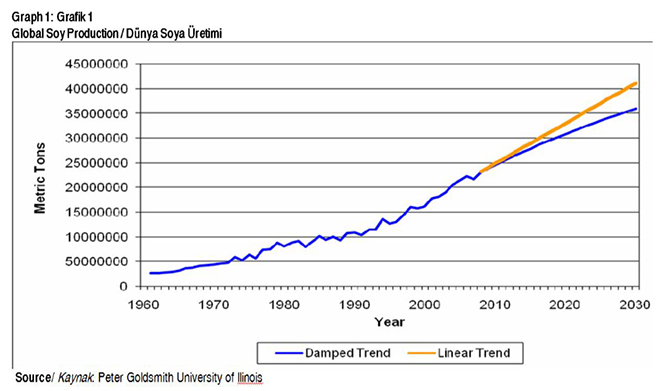
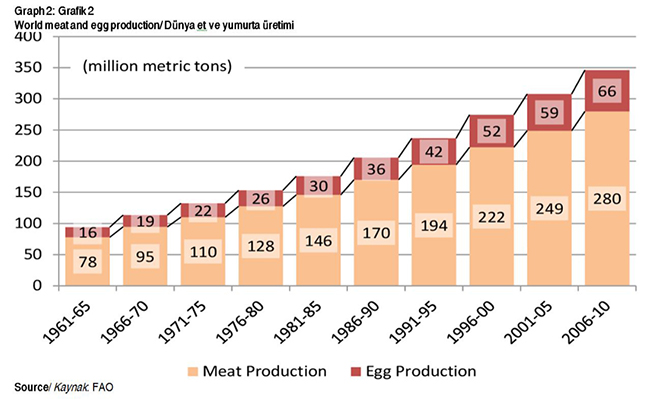
According to the International Grain Council (IGC) report, total soybean production in the world is 359 million tons in MY 2018/19. Production is estimated to be 341 million tons in MY 2019/20. According to the US Department of Agriculture (USDA), world soybean production is estimated to be around 337.48 mt in MY 2019/2020.
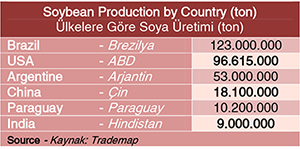 Soybean production was 358.21 million tons last year. This year's forecast is estimated at 337.48 million tons. Total soybean production worldwide is estimated at 20.73 million tons, down by 5.79 percent.
Approximately 80% of the world production is carried out by three countries.
GLOBAL SOYA EXPORTING COUNTRIES
According to 2018 figures, China-US tension in exports was reflected in the scene. Brazil has increased its exports, while a decline has been observed in the USA. Chinese imports declined in 2018-2019. China imports around 80% of its needs. The trade tension between the US and China has caused Chinese imports to shift to Brazil. In the table below, US imports of China declined from around $14 million in 2017 to $7 million in 2018.
Global soybean exporting countries are shown in the table below. Brazil increased its exports due to the Chinese effect and this situation had a negative impact on the USA. US tariffs on China have negatively impacted China's food prices. Consumer inflation in China is at its highest level in the last eight years. As a matter of fact, China is now cautious about trusting the US regarding soybeans and looking for new alternatives. Although Brazil and Argentina are among the alternatives, it is highly likely that the two countries will reduce sales to meet their commercial obligations to the US.
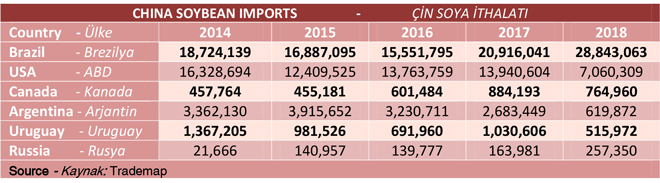
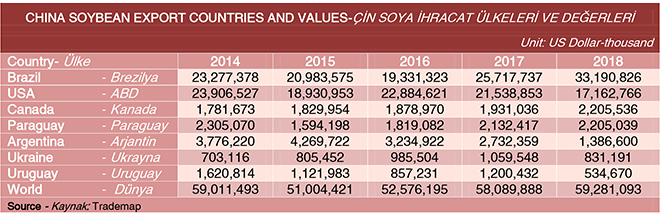
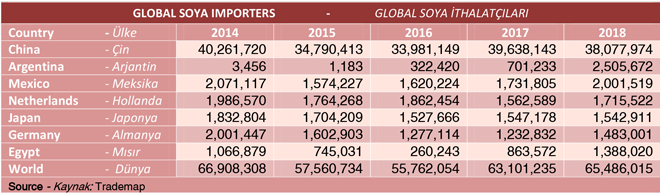
The trade tension between China and the US affected the import figures as well. The losses experienced in Argentina due to adverse climate conditions in 2017 also showed their effect on imports. It is the most crucial example of how the gradually growing global climate danger actually affects agricultural products. Argentina, which is an exporter country, had to import almost 3 times the amount of the previous year.
GLOBAL SOYA IMPORTING COUNTRIES
The question is: Will China be able to find alternative sellers?
Looking at the Chinese import table, alternative countries are seen as Latin American countries. As a result, it is seen that Argentina realizes most of its exports to China thanks to the import support it gets from the USA.
Although Latin American countries are seen as an alternative, it seems certain that imports from these countries will cause high costs for China.
Another alternative is the Asian countries. Since July 1, 2018, China has reduced tariffs for India, South Korea, Bangladesh, Laos, and Sri Lanka. India is remarkable among these countries. According to 2016 reports, India's annual soybean production increased by 63%. Although India may be considered as a solution in the long term, it is estimated that China will have problems meeting its soy needs. 60% of India's import is being shipped to the United States. At this point, it is highly possible to encounter US pressure again.
Another question: Will the US be able to find alternative buyers?
In fact, this question can be answered by looking at the areas of soybean usage. The US seems more fortunate in this matter when compared to China, the major buyer. The most important uses of soy are animal feed, which accounts for more than 70% of total feed use, followed by human consumption (18%), biodiesel (6%) and industrial use (2%). Soybeans are mostly processed in the form of SBM (soybean meal) and SBO (soybean oil).
There is an increase in developing Southeast Asian countries, such as Vietnam, Indonesia, Thailand, and the Philippines, which are global buyers for SBM. In Europe, the Netherlands and France are the largest soy and SBM importers. However, for European countries, non-GMO SBM accounts for 75% of the total feed market.

The Netherlands, the largest soybean or SBM importer in Europe, mainly imports from Brazil and Argentina. A sharp increase in prices of soybean imported from Brazil and Argentina could take the USA a step forward regarding the buyer problem. Rising soybean prices increase this possibility.
In conclusion;
Soybean prices experienced a fluctuation until 2018. The on-going trade war between the USA and China was the most important factor in the volatility of the market. Independently of this case, global soybean supply and demand are increasing. Market growth, driven by the livestock sector and expanding plantation areas, is expected to continue.
Nutritional habits are changing all over the world, awareness about nutrition is becoming more widespread and protein-based nutrition is becoming more important. Agricultural production is increasing its significance in almost every field. The best example of this is soybean which is named ‘the miracle product’.
As China seeks to increase production, the USA will try to find new markets with new scenarios. The tension between the US and China seems to keep agricultural commodities busy for a long time.